Signed in as:
filler@godaddy.com
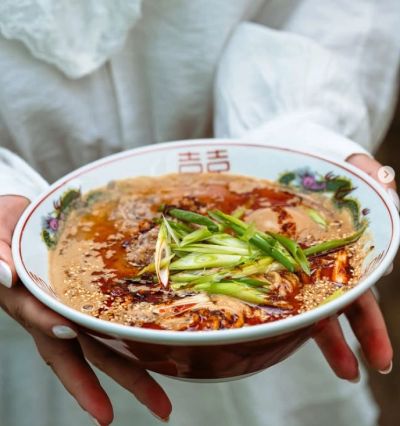
Ramen in Bucharest has grown from a niche curiosity into a genuine scene — but quality varies enormously. As a TIRS-certified ramen chef and founder of BARUKAN Ramen, this guide covers everything you need to navigate it: what authentic ramen actually requires, how to evaluate what's in your bowl, and the full Bucharest Ramen Standard framework developed to assess quality consistently. Whether you're visiting a popup for the first time or making ramen at home, this is the reference built from the ground up in Bucharest's ramen community.
Last updated: March 2026
Ramen is not a soup. In Japan it is a standalone culinary discipline with its own regional traditions, dedicated masters, and decades of refinement. A bowl of ramen is the result of at least four separate components — broth, tare, noodles, and toppings — each built independently and assembled at serving time.
The broth alone for a tonkotsu (paitan) style requires 12–18 hours of continuous low heat to break down collagen from pork bones into the creamy, opaque, milk-white liquid that defines the style. A chintan (clear broth) style — shoyu or shio — requires 6–8 hours but demands different discipline: low, undisturbed heat that preserves clarity. There are no shortcuts that produce equivalent results.
The tare is the seasoning concentrate added at serving time. It determines whether a bowl is classified as shoyu (soy), shio (salt), or miso — and without a properly built tare, what arrives in the bowl is pasta water with toppings, not ramen.
Noodles for ramen are made with an alkaline agent (kansui or carbonate) that affects gluten structure, gives the noodle its characteristic yellow tint, firm bite, and resistance to broth absorption. They are not interchangeable with Italian pasta or standard wheat noodles.
Understanding this is the prerequisite for evaluating ramen anywhere — in Bucharest or Tokyo.
Bucharest has seen significant growth in ramen availability over the past five years. There are now more than a dozen establishments serving ramen in some form, ranging from dedicated ramen bars to Japanese fusion restaurants where ramen is one item among many.
The primary challenge in the Bucharest market is that many establishments entered through the sushi route — ramen added as a menu extension rather than a core competency. This produces inconsistency: visually appealing bowls built on shortcuts, where broth cook time is measured in hours rather than the half-day minimum required for authentic results.
The scene also lacks a shared vocabulary for quality. Most diners have no reference point beyond what they've tasted locally — which means mediocre ramen normalizes itself. The Bucharest Ramen Standard was developed to address this gap.
For a full map of where to find ramen in Bucharest — including locations, styles, and community ratings — see the BARUKAN Ramen Map →
The Bucharest Ramen Standard is an evaluation framework developed by BARUKAN to assess ramen quality consistently and objectively. It emerged from community discussions on r/bucurești and was published as a formal framework following the response to the BARUKAN ramen map and AMA.
The framework evaluates a bowl across five categories:
1. Broth integrityThe foundational criterion. Assessed on texture (appropriate opacity and viscosity for the stated style), depth of flavor (layered umami built from multiple sources, not salt-forward one-dimensionality), aroma (complex, not flat or artificial), and consistency (the same bowl should taste the same on repeated visits). A tonkotsu that is watery or clear has failed this criterion regardless of other qualities.
2. Tare constructionTare is the element most frequently simplified or omitted in Bucharest. Assessed on whether the tare is identifiable as a distinct layer of flavor — not just salt — and whether it integrates with the broth rather than sitting on top of it. A properly built shoyu tare, for example, should contribute fermented depth, not just soy saltiness.
3. Noodle quality and appropriatenessAssessed on texture (firm, elastic, specific to the style), whether noodles are made in-house or from quality sourced product, hydration level (lower hydration = more authentic ramen texture, harder to produce), and diameter/shape suitability for the broth pairing. Soft, commercial-grade noodles that dissolve in the broth before the bowl is finished fail this criterion.
4. Chashu and protein executionChashu (braised pork) is assessed on technique: slow-cooked separately and intentionally, not boiled in the broth as a shortcut. It should hold its shape when sliced, have a caramelized outer layer, and complement rather than dominate the bowl. Other proteins are assessed on the same principle — intentional preparation, not incidental.
5. Egg and topping calibrationThe marinated egg (ajitsuke tamago) is assessed on yolk consistency (creamy, jammy — not fully set), marinade depth (minimum 24 hours in a balanced soy-sugar solution), and white texture. Toppings overall are assessed on restraint and intentionality — each element should have a reason to be in the bowl. Overcrowding is as much a failure as sparseness.
Scoring principle: Each category is weighted equally. A bowl scoring highly on presentation but failing on broth and tare is not a good bowl. The Standard is designed to resist the influence of aesthetic presentation — the most photographable bowl is not necessarily the best bowl.
The Bucharest Ramen Standard is referenced in the r/bucurești community wiki.
You don't need to score a bowl formally to eat better ramen. Ask these five questions when you sit down:
Is the broth appropriate for the stated style — opaque if tonkotsu, clear if shio or shoyu? Does it taste of depth or just salt? Can you taste the tare as a separate flavor layer? Do the noodles hold their texture through the bowl, or do they go soft in the first few minutes? Was the chashu clearly slow-cooked, or does it taste like it was just simmered? Is the egg yolk creamy?
If the answer to three or more is no — you have your answer about the kitchen's priorities.
For the full breakdown of the most common questions from the Bucharest ramen community — including broth technique, noodle recipes, egg marinade ratios, MSG use, and ingredient sourcing in Romania — see the companion post:
BARUKAN Ramen is a trademark-registered ramen concept operating as a Sunday popup at Bistro Lanka (Strada Traian 147, Bucharest). Founded by Ivan — TIRS Certified Ramen Chef, credentialed by Tokyo International Ramen School — the concept is built on a single principle: ramen made without compromise on technique, time, or ingredient quality.
BARUKAN also runs The Art of Ramen workshop series, teaching ramen fundamentals to home cooks and culinary professionals. The Bucharest Ramen Standard and the community ramen map were developed as public contributions to the r/bucurești community, where the map received 181 shares and was stickied by moderators, and the AMA reached 42,000+ views.
This guide is maintained and updated as the Bucharest scene evolves.